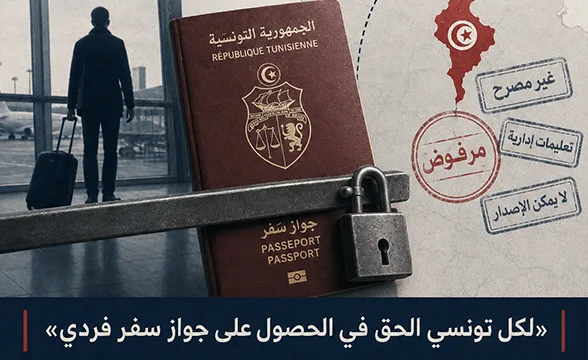
The Freedom for Tunisia Observatory is monitoring with deep concern the numerous accounts regarding delays in the issuance and renewal of passports for Tunisians—particularly those residing abroad, including dissidents, politicians, media figures, and former officials.
Reported cases reveal a recurring pattern: renewal applications are accepted, old passports are surrendered, and fees are collected, yet the files remain pending for weeks or months. This occurs under the pretext of awaiting an “internal procedure” or a “response from Tunisia,” without any specified timeframe for a decision, the issuance of a written and detailed ruling, or the provision of an opportunity for the affected individual to exercise their right to appeal or challenge the delay.
The Observatory maintains that this unexplained stalling is not merely a matter of administrative delay; in practice, it functions as a de facto rejection and travel ban, effectively transforming the passport into an “administrative penalty” that bypasses legal and judicial safeguards.
A passport is neither a political favor nor a privilege; it is an essential document of citizenship required to exercise fundamental rights—foremost among them the freedom of movement, the right to work, the right to family life, and the right to participate in public affairs.
A passport is neither a political favor nor a privilege; it is an essential document of citizenship required to exercise fundamental rights—foremost among them the freedom of movement, the right to work, the right to family life, and the right to participate in public affairs.
I. The Case of Habib Ben Sidhom: From Delay to Resolution
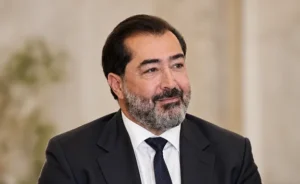
Lawyer and former MP Habib Ben Sidhom, who resides in Qatar, submitted an application to renew his passport at the Tunisian Embassy in Doha on July 1, 2026. According to his account, he surrendered his old passport, paid the required fees, and requested expedited processing of his file due to professional commitments arising from his work as a lawyer and a consultant for sports organizations. He was informed of an “internal administrative procedure” concerning his file, yet he received no written decision, legal justification, or specific timeframe for the passport’s release. This delay, which lasted over a month, hindered his ability to travel and jeopardized his participation in conferences, training courses, and the handling of professional matters and obligations outside Qatar.
On August 9, 2026, Ben Sidhom announced in a post—accompanied by a photo of his passport—that he had received the document from the embassy. The Observatory notes that this subsequent resolution does not negate the prior, unexplained delay, nor does it obviate the need to clarify the reason for the suspension of his file and to ensure that such an incident does not recur with others.
II. Similar cases in other countries
Habib Ben Sidhom’s case does not appear to be isolated. In recent years, similar cases have been reported in France, Qatar, Germany, and Japan, including:
- Imed Daimi, an opposition politician based in France, who submitted a passport renewal application to the Tunisian consulate in Pantin on January 13, 2026. He stated that on March 10, 2026, he was verbally informed that renewal was not possible based on a decision by the Ministry of the Interior, without being provided with a written copy or the reasoning behind the decision.
- Elyes Chaouachi, son of opposition figure and political prisoner Ghazi Chaouachi, who faced delays in renewing his passport in 2023 before finally receiving the new document on December 2, 2023, following a public solidarity campaign.
- Maher Medhioub, a former assistant to the Speaker of the Assembly of the People’s Representatives based in Qatar, who stated that he submitted a renewal application to the consular section of the Tunisian Embassy in Doha on January 2, 2025. According to his account, after months of waiting, he was verbally informed that he needed to return to Tunisia to “settle his status,” without receiving a written decision or legal justification. He noted that his correspondence with the ambassador, the ministers of foreign affairs and the interior, and the Presidency of the Republic had not resulted in the resolution of his case as of the time of his statement.
- Oussama Ladhari, a media figure overseeing the digital channel “Al-Balagh” and based in Japan, who announced that his passport renewal had been stalled since September 2025, without any judicial ruling or public administrative explanation. According to reports by “Masarat,” he was informed of the need to return to Tunisia to “settle his status,” despite asserting that there were no outstanding judicial or security cases against him in Tunisia.
- Fathi Ayadi, an engineer and former senior figure in the Ennahdha Movement residing in Germany, stated to Masarat that he was unable to renew his passport. While unable to pinpoint the exact reason for the delay, he noted his participation in the remote parliamentary session held on March 30, 2022, and the fact that he is subject to legal proceedings alongside Moncef Ounissi.
- Sami Essid, Director General of the Zitouna Media and Communication Network—who has lived outside Tunisia since 2021—reported that after months of inquiries at various consulates, he was ultimately told he must return to Tunisia to resolve the matter. He states that the obstruction of his passport renewal has persisted since 2022, amidst ongoing legal cases and in absentia judgments that he links to the activities of the Zitouna channel.
III. Subsequent resolutions reveal a lack of clear criteria
Other cases demonstrate that passport delays do not follow a uniform timeline; some issues are resolved only after being raised publicly—though this does not necessarily prove a causal link between the public campaign and the document’s issuance.
For instance, Admiral Kamel Akrout announced on March 17, 2026, that he was facing stalling tactics regarding his passport renewal, only to announce the very next day that he had been contacted to collect his new passport. Similarly, politician Mohsen Marzouk complained in March 2026 about delays in the issuance of his passport, despite having submitted his application months earlier.
These examples underscore the need for standardized criteria, publicly stated processing timeframes, and an effective grievance mechanism, ensuring that the issuance of the document does not depend on public attention or interventions on the applicant’s behalf.
IV. Stalling as an Implicit Rejection and a De Facto Travel Ban
Leaving a passport application pending indefinitely—after all procedures have been completed and fees paid—does not constitute a neutral delay; in practice, it functions as a rejection and a travel ban. This tactic allows the administration to avoid issuing an explicit decision, thereby depriving the affected individual of the ability to identify the responsible authority or the legal basis for the action, and preventing them from exercising their rights to file a grievance, lodge an appeal, or seek compensation.
Consequently, the phrase “file being processed” transforms into a means of imposing an indefinite ban—one that bears neither the name of a ban nor the associated legal safeguards. Furthermore, a travel document is not a substitute for a passport; it is restricted in terms of destination and usage, and does not enable the holder to fully exercise their right to international travel or fulfill their professional and family obligations.
V. Constitutional and Legal Framework
Article 30 of the Constitution of the Tunisian Republic stipulates the right of every citizen to freedom of movement and to leave the country. Meanwhile, Article 55 requires that any restriction on rights be prescribed by law, be necessary and proportionate, and not infringe upon the essence of the right. Furthermore, Article 23 enshrines equality before the law, and Article 19 affirms that the public administration serves the citizen based on principles of neutrality and equality.
The new Article 8 of the Law on Passports—as amended by Organic Law No. 23 of 2024—expressly states that “every Tunisian has the right to obtain an individual passport.” Consequently, the administration may not establish a parallel system for restricting travel through security directives or undisclosed “internal procedures.”
Additionally, the 2017 amendments subjected travel restrictions to judicial oversight. This means that invoking public order or security does not exempt the administration from the requirement to seek a judicial ruling—one that is reasoned, time-bound, and subject to appeal.
On July 6, 2023, former Minister of the Interior Kamel Feki issued public instructions emphasizing the “necessity of enabling every Tunisian citizen to obtain their documents.” This directive applied to all citizens—including those subject to wanted notices, those involved in common law cases, and those with criminal records—while urging them to regularize their legal status; the only exception was made for wanted individuals involved in cases of extremism and terrorism. The persistence of suspension cases following these instructions necessitates an official clarification regarding the continued applicability of the directive and the criteria currently being enforced.
VI. Violation of Tunisia’s International Obligations
Article 13 of the Universal Declaration of Human Rights, Article 12 of the International Covenant on Civil and Political Rights, and Article 12 of the African Charter on Human and Peoples’ Rights guarantee everyone the right to leave any country, including their own, and to return to it.
These instruments permit restrictions on the right to freedom of movement only if prescribed by clear law, pursued for a legitimate purpose, and meeting the requirements of necessity and proportionality, while ensuring an effective means of legal challenge. Furthermore, the UN Human Rights Committee affirms that the right to leave a country entails enabling citizens to obtain the necessary travel documents.
Consequently, obstructing the issuance of a passport, conditioning it on undisclosed instructions, or failing to provide a written decision may constitute a direct interference with freedom of movement and a deprivation of the means necessary to exercise that right.
VII. A Return to Pre-Revolution Practices
The use of travel documents to pressure dissidents raises serious concerns about a return to the practices of the authoritarian era. During that time, passport applications were left “under review” for years, and dissidents, human rights defenders, and their family members were targeted through the confiscation or refusal of passports.
Human rights organizations have previously documented the denial of travel documents to thousands of Tunisians for political reasons during the reign of Zine El Abidine Ben Ali—including the case of Moncef Ben Salem and his daughter, Mariem—before the administrative courts ruled in 2009 that the denial of his passport was unlawful.
The recurrence of stalling tactics, the refusal to provide reasons for decisions, and the use of political activity or family ties as undisclosed criteria represent a setback for human rights and a revival of tools used for security-based control and surveillance.
Position of the Tunisia Freedom Observatory
The Freedom for Tunisia Observatory welcomes the handover of a passport to lawyer Habib Ben Sidhem on August 10, 2026, and considers the resolution of his status a positive step that restores a document essential for exercising his right to freedom of movement and his profession.
However, the Observatory emphasizes that this belated handover does not absolve the authorities of the duty to explain the reasons for the delay, nor does it negate the affected individual’s right to know who made the decision and the legal basis relied upon. Furthermore, it does not imply the resolution of other reported cases.
The Observatory condemns the obstruction of the issuance or renewal of passports for dissidents, human rights defenders, and their family members—whether motivated by their stances or activities—and rejects the transformation of embassies and consulates from public services dedicated to Tunisians abroad into instruments for implementing undeclared directives.
The Observatory holds the Ministries of Interior and Foreign Affairs responsible for ensuring adherence to the law within diplomatic and consular missions, and for the professional, familial, and legal damages resulting from such unlawful obstruction.
Urgent Demands to Tunisian Authorities
The Tunisia Freedom Observatory calls for:
- Resolving the status of all Tunisians whose applications for passport issuance or renewal have been delayed indefinitely for undisclosed reasons.
- Returning old passports to their holders if new passports are not issued within a reasonable administrative timeframe, ensuring that the retention of old passports does not become a means to prevent travel.
- Halting all undeclared security or administrative directives aimed at obstructing passport procedures for dissidents, human rights defenders, or their families.
- Providing any individual whose application is rejected or suspended with a written, reasoned decision specifying the issuing authority, the legal basis, the facts of the case, and the available avenues and timeframes for appeal.
- Ensure that no travel bans or restrictions are implemented except in accordance with the law, pursuant to a decision by a competent authority, and subject to judicial oversight.
- Establish clear and reasonable statutory timeframes for processing passport issuance and renewal requests, and deem any unexplained failure to meet these deadlines an administrative error warranting accountability.
- Launch independent administrative investigations into reported cases and identify the entities that ordered the suspension of files or refrained from processing them.
- Publish periodic data regarding the number of passport requests suspended or rejected at embassies and consulates, as well as processing times and reasons for rejection.
- Provide redress for damages resulting from unlawful delays, including professional losses, expenses, and legal or family-related consequences.
- Issue a binding public directive to consular missions affirming that political views, human rights activism, or family ties cannot constitute grounds for obstructing any consular service.
Call to national institutions and organizations
The Freedom for Tunisia Observatory calls upon:
- The Assembly of the People’s Representatives to hold the Ministers of Interior and Foreign Affairs accountable and request official data on passports suspended abroad.
- Members of Parliament representing Tunisians abroad to document cases and submit a legislative initiative defining timeframes for issuance and renewal, as well as safeguards for legal challenges.
- The Administrative Court to treat requests for the suspension of execution regarding travel documents with the necessary urgency, given the potential for irreparable harm.
- The National Bar Association of Tunisia to monitor the situation of affected lawyers and provide legal support to challenge explicit or implicit rejection decisions.
- The Tunisian Human Rights League, along with human rights and trade union organizations, are called upon to establish a joint mechanism to monitor instances where individuals are denied travel documents and to provide assistance to those affected.
- Tunisian organizations and associations—both within and outside Tunisia—are urged to document every case involving the refusal, undue delay, or withholding of passports, while preserving submission and payment receipts, correspondence, and consular responses.
Call to international and regional organizations
The Freedom for Tunisia Observatory calls upon:
- The Office of the United Nations High Commissioner for Human Rights to monitor this pattern of violations and raise the issue with the Tunisian authorities.
- The UN Special Rapporteur on the situation of human rights defenders to address the Tunisian government regarding the targeting of human rights defenders and their family members through travel document restrictions, should this be substantiated.
- The Special Rapporteur on the promotion and protection of the right to freedom of opinion and expression and the UN Human Rights Committee to examine the link between passport obstruction and the punishment of individuals for their political stances or peaceful expression.
- The African Commission on Human and Peoples’ Rights and its Special Rapporteur on Human Rights Defenders to monitor these cases and assess their compliance with Article 12 of the African Charter.
- The International Association of Lawyers and the International Bar Association’s Human Rights Institute to document the situations of lawyers—such as Mr. Habib Ben Sidhem, even where resolved—and to monitor how the obstruction of lawyers’ passports impedes the practice of their profession.
Practical Recommendations for Those Affected
The Observatory recommends that anyone facing such obstruction:
- Retain the receipt for the application submission and fee payment.
- Submit a written inquiry to the embassy or consulate regarding the status of the file.
- Demand a written, reasoned decision in the event of rejection or suspension.
- Document verbal responses, dates of communication, and the names of the relevant parties.
- Send registered correspondence to the Ministries of Foreign Affairs and the Interior.
- Consult a lawyer regarding filing a grievance or challenging the decision (whether explicit or implicit) and, where appropriate, requesting a stay of execution.
- Document the professional, familial, and financial damages resulting from the delay.
- Refer the case to national and international human rights organizations if there is a suspicion of political or retaliatory motives.
- Contact the Observatory to report violations via email (contact@freedom4tunisia.com), the “Report a Violation” form, or the Facebook page (via private message).