Skip links

On Tunisian Women’s Day: Tunisian Women Behind Bars or Facing Prosecution for Their Views and Activism

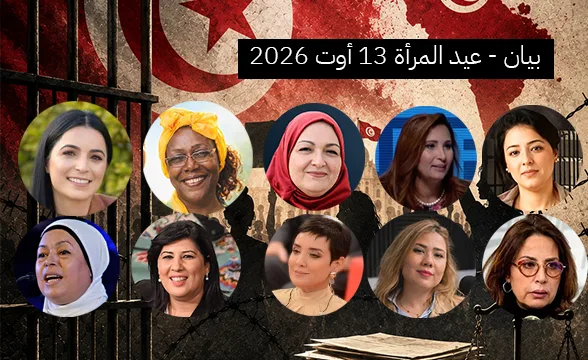
August 13, 2026 | Freedom for Tunisia Observatory – Tunisian Women’s Day arrives this year at a time when Tunisian women are languishing in prison or facing sentences and legal prosecution due to their views, stances, and activities—spanning the political, human rights, media, and civil spheres. This situation stands in stark contrast to the historical symbolism of August 13 regarding women’s rights, freedoms, and participation in public life.

The Freedom for Tunisia Observatory maintains that celebrating women’s achievements cannot be divorced from the reality of the freedoms women enjoy today—foremost among them the right to freedom of expression, political participation, and engagement in human rights and civil society work without fear of imprisonment, prosecution, or reprisal.

Prominent women from diverse political and human rights backgrounds are currently imprisoned—including Chaima Issa, Abir Moussi, Siwar Bargaoui, Olfa Hamdi, Saadia Mosbah, and Boutheina Ben Yaghlane. While the nature, legal proceedings, and verdicts of their cases vary, they all occur within the context of expanding prosecutions targeting opposition figures and public actors in recent years.

Other Tunisian women also face sentences, prosecutions, or legal proceedings, including Meriem Sassi, Sonia Dahmani, Sihem Bensedrine, Chadha Haj Mbarek, Cherifa Riahi, Imen Ouardani, Salwa Grissa, Dalila Ben Mbarek Msaddek, Islam Hamza, and Monia Arfaoui. These prosecutions have extended to Tunisian women residing abroad, such as Bochra Belhaj Hmida, Nadia Akacha, Khaoula Boukrim, and Soumaya and Tasnim Ghannouchi. The Observatory notes that this list is not exhaustive; other women have faced arrests or legal proceedings without their names being publicized or their cases receiving media or civil society attention, indicating that the scope of targeting extends beyond the publicly known cases.

The Freedom for Tunisia Observatory asserts that the diverse political and ideological affiliations of these women do not alter the fundamental human rights principles that must apply to everyone. Imprisonment, judicial prosecution, and harassment must not be transformed into tools to punish women for their views and stances or to exclude them from public life; nor should peaceful political, human rights, journalistic, or civic activities become grounds for intimidation and reprisal.

On the occasion of August 13th, the Freedom for Tunisia Observatory calls for the release of all women imprisoned due to their views or their peaceful political, human rights, and civic activities. It demands an end to politically motivated prosecutions or those linked to freedom of expression, a halt to the harassment and intimidation of female activists, journalists, lawyers, and human rights defenders, and a guarantee of judicial independence and fair trials in all cases.

The Observatory emphasizes that women’s achievements are not measured solely by legal texts and official celebrations, but rather by the extent to which women genuinely enjoy freedom, dignity, and the right to hold differing views and participate in public affairs.
Share

More Posts

Suspicious Death of Salem Karmous in Messaadine Prison, Who Returned to Tunisia in Summer 2026 to Prepare for His Wedding- Family Reports Signs of Beating on His Body

The death of prisoner Salem Karmous inside Messaadine Prison in Sousse Governorate—occurring just two weeks after his incarceration—has raised serious questions regarding the circumstances of his passing. His father, in a statement recorded by the website Nawaat, reported observing signs of beating, bruises, and blue marks on his son’s body and head while preparing the remains for burial.

Call to Action

Website petition: Freedom for prisoners of conscience and activists in Tunisia!

Tunisia is no longer the Arab exception that inspired the world in 2011 with a heroic revolution that overthrew the rule of Zine El Abidine Ben Ali, who ruled for nearly 23 years after seizing power on November 7, 1987, in a coup against Habib Bourguiba.

In a similar and perhaps more dangerous move, on the night of July 25, 2021, Tunisian President Kais Saied carried out a “constitutional coup” in accordance with his personal interpretation of Article 80 of the 2014 Revolutionary Constitution, announcing that he had taken a set of exceptional measures due to the “imminent danger” that threatens Tunisia without providing any details or reasons.

In accordance with these measures, Saied dismissed the government and the prime minister Hichem Mechichi who was present at the National Security Council that night at the Carthage Palace, and claimed that he had contacted the Speaker of Parliament Rached Ghannouchi (leader of the Ennahdha party) to consult with him in accordance with what is stipulated by the constitution, a claim which Ghannouchi denied since the call was general and did not include anything about exceptional measures or any consultation on the matter. The president suspended Parliament and later dissolved it in March 2022.

Not only did Saied seek to bypass his powers and the articles of the Constitution, which he swore to protect before the Assembly of the Representatives of the People, but he went on to dismiss and change the composition of the Supreme Judicial Council after redefining the judiciary it as a “function” rather than an independent authority. He further replaced members of the Supreme Electoral Commission in preparation for the referendum he held in order to vote on a constitution that he wrote himself after dismissing the proposals of the drafting committee he had himself appointed. Then legislative elections were held over two rounds, in which the participation rate did not exceed 8% of the total number of voters, with the Election Commission later announcing that it had reached 11%, which is the lowest participation rate in Tunisia and globally.

On February 11, President Saied’s regime launched a campaign of protests that has not stopped since, against political leaders, media figures, journalists, judges and senior officials and civil servants, for charges of “conspiring against the security of the state and committing an offensive act against the President of the Republic,” in addition to other charges that were referred to the military prosecution, leading one to wonder about the implication of the Tunisian army in the actions taken by Saied.

The arbitrary arrests were marred by several procedural violations amid criticism from prominent international organizations and observatories in the field of human rights. The standards of litigation and detention period and conditions were not respected. Prosecution and harassment sometimes extended to the detainees’ families, and no evidence, and in many cases, no charges against them were presented.

Moreover trade unions and political parties continue to be subjected to constant harassment and restrictions. Saied continues to target all “intermediary bodies” accusing them of “collaboration” or “treason”. Civil society associations have also been subjected to prosecution, arbitrary arrests and deprivation from representation, in a context of of increasing violence in society due to the authorities’ adoption of racist and discriminatory speeches and rhetoric inciting infighting and violating human dignity.

In light of the above, we, the undersigned, demand the following:

Call for the immediate release of all political detainees, immediately and unconditionally. We also urge the Tunisian authorities to recognize the national and the international human rights treaties they have ratified.
Call on the Tunisian authorities to stop dismantling the nascent democracy and put an end to unfair trials and prosecutions against political opponents of the regime and anyone who criticises it.
Call on all activists and observers to join the national movement for restoring democracy and ending authoritarian rule that has taken Tunisia back to despotism, injustice, and violations of rights and freedoms.