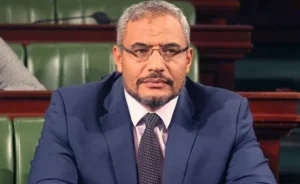

November 5, 2026 – The Criminal Chamber specialising in financial corruption cases at the Tunis Court of First Instance has decided to adjourn the trial of Sihem Ben Sedrine, former President of the Truth and Dignity Commission, and Khaled Krichi, a former member of the Commission and Chairman of its Arbitration and Reconciliation Committee, until November 19, 2026. The case concerns an arbitration and reconciliation agreement concluded by the Commission with the late businessman Lazhar Sta.
Sihem Ben Sedrine appeared before the court while on bail, while Khaled Krichi was brought from prison to attend the hearing. The court subsequently decided to adjourn the proceedings for further examination of the case.
The case concerns allegations of irregularities and procedural violations in the conclusion of the arbitration and reconciliation agreement with the late businessman, including whether the procedures complied with applicable laws. It is separate from other cases in which judgments have previously been issued against Ben Sedrine and Krichi.
Previous Sentences of 25 Years Against Ben Sedrine and 10 Years Against Krichi
In June 2026, the Criminal Chamber specialising in financial corruption cases issued first-instance judgments in two cases separate from the Lazhar Sta proceedings.
In the case concerning the arbitration and reconciliation agreement with businessman Slim Chiboub, the court sentenced Sihem Ben Sedrine and Khaled Krichi to five years in prison each. Other sentences were also imposed, including against Slim Chiboub and former Minister of State Property Mabrouk Korchid.
The second case concerned the Franco-Tunisian Bank. In those proceedings, the court sentenced Ben Sedrine and Krichi to five years in prison each, in addition to a separate 15-year prison sentence against Ben Sedrine on charges relating to forgery and the possession and use of forged documents.
The total first-instance prison sentences imposed on Sihem Ben Sedrine therefore reached 25 years, compared with 10 years for Khaled Krichi. Appeals against these judgments remain ongoing, and the convictions have not become final.
Seven Cases Linked to the Work of the Truth and Dignity Commission
Sihem Ben Sedrine faces a series of criminal proceedings connected to her former role as President of the Truth and Dignity Commission. Meanwhile, several former Commission officials continue to face trials in cases concerning decisions taken during the implementation of the transitional justice process, including arbitration and reconciliation procedures.
Amnesty International has stated that the cases brought against Ben Sedrine are linked to her legitimate work as head of the Truth and Dignity Commission. The organisation has called for the judgments against her to be overturned and for an end to prosecutions connected to her human rights activities and her work within the Commission.
Position of the Freedom for Tunisia Observatory
The Freedom for Tunisia Observatory condemns the continued pursuit of multiple judicial proceedings against Sihem Ben Sedrine, Khaled Krichi and former officials of the Truth and Dignity Commission over actions and decisions taken during the implementation of the transitional justice process. It warns that these prosecutions risk becoming a campaign of retaliation against the Commission and its members because of their role in exposing human rights violations and holding those responsible accountable.
The Observatory considers that the multiplicity of cases and severe prison sentences, totalling 25 years for Sihem Ben Sedrine and 10 years for Khaled Krichi, raise serious concerns that the transitional justice process is being dismantled through judicial proceedings, with those who oversaw it being prosecuted instead of safeguarding its achievements and ensuring the fulfilment of its objectives.
The Observatory further stresses that disputes concerning certain arbitration and reconciliation agreements or the manner in which procedures were implemented should not automatically result in the criminalisation of the Commission’s work or the imposition of criminal liability on its members merely for taking decisions within the scope of their legal authority.
The Observatory warns in particular that repeated prosecutions risk undermining the legacy of the Truth and Dignity Commission, stripping the transitional justice process of its substance, and sending a threatening message to everyone who participated in exposing or documenting violations or defending victims’ rights.
The Observatory emphasises that transitional justice is not a process that can simply be closed by terminating the Commission’s work or prosecuting its members. Rather, it represents an ongoing obligation of the state towards thousands of victims, the families of those killed, the families of the forcibly disappeared, and victims of torture, political persecution and economic violations.
The Observatory considers that the state’s duty is to complete the process of establishing the truth, implement reparations decisions, protect the Commission’s archives, continue holding perpetrators of serious violations accountable, and guarantee the rights of victims, those killed and their families to truth, justice and redress, rather than subjecting those who oversaw this process to an ongoing series of trials.
The Freedom for Tunisia Observatory Calls For:
- An end to the retaliatory approach towards the Truth and Dignity Commission and its former officials, and guarantees that disagreements over the Commission’s decisions or activities are not used as a means of criminalising the transitional justice process.
- A review of the severe sentences imposed on Sihem Ben Sedrine and Khaled Krichi, as well as guarantees of independent and fair trials that clearly distinguish individual criminal responsibility from the lawful exercise of duties within the Truth and Dignity Commission.
- An end to the prosecution of Commission members for decisions taken within the scope of their legal powers, unless clear evidence establishes that they personally committed distinct criminal acts.
- Guarantees of judicial independence from political disputes surrounding assessments of the transitional justice experience, and an end to the use of the courts to settle past disputes with the Commission or its former officials.
- Protection of the Truth and Dignity Commission’s archives, including all documents, testimonies and case files collected by the Commission, and guarantees against their tampering, misuse or any obstruction of their use in exposing violations and holding perpetrators accountable.
- Completion of the transitional justice process and fulfilment of obligations relating to truth-seeking, reparations, the restoration of victims’ dignity, and redress for victims, the families of those killed, the forcibly disappeared, and victims of torture and serious human rights violations.
- Continued investigation and prosecution of the crimes and violations documented by the Truth and Dignity Commission, ensuring that proceedings against former Commission officials do not obstruct efforts to hold perpetrators of human rights violations accountable.
- Guarantees of victims’ and their families’ rights to truth, justice and redress, and protection against the erasure of national memory or the reversal of the achievements made by the transitional justice process since the revolution.