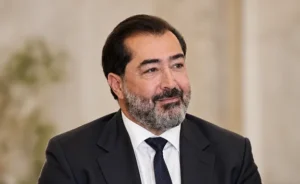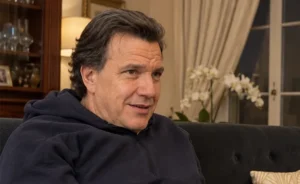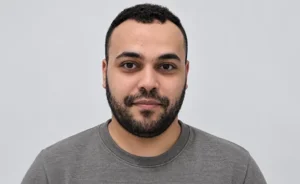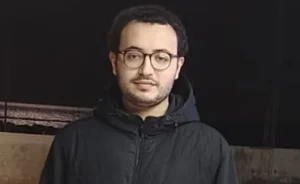
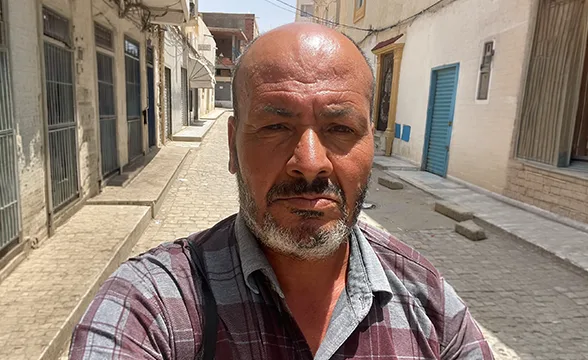
The Public Prosecutor’s Office in Gafsa has appealed the initial ruling to dismiss the case against journalist Hedi Raddaoui. The preliminary ruling had been issued following a news report covering a protest organized by staff of the National Authority for Food Safety (ONSSA) in Gafsa. The initial judgment, delivered on July 14, 2026, also covered Makram Hosni, the Secretary-General of the local union representing the Authority’s staff in the region.
The prosecution’s appeal means the case will now move to the appellate stage, following the Court of First Instance’s decision to acquit both the journalist and the union activist of the charges brought against them.
Case Background
The case dates back to September 2025, when Hedi Raddaoui produced a video report—published on the “Kashf Media” and “Al-Chaab News” platforms—covering a protest organized by staff of the National Authority for Food Safety in Gafsa, under the auspices of their local union.
During the protest, participants demanded the issuance of regulations governing their career paths and the settlement of their financial rights and entitlements. They also expressed their opposition to administrative measures and practices they deemed obstructive to the performance of their duties. Following the report’s publication, the National Authority for Food Safety in Gafsa filed a complaint against Hedi Raddaoui and Makram Hosni, leading to their referral to the Court of First Instance in Gafsa.
Raddaoui and the union representative appeared before the Public Prosecutor on February 12, 2026, and were released pending further proceedings. During the hearing on April 14, the defense requested a postponement to review the case file and prepare their pleadings; consequently, the hearing for oral pleadings was scheduled for June 23.
At the June 23 hearing, the defense team argued that the referral to court was invalid and requested a ruling of inadmissibility (dismissal of the case), while the public prosecutor sought a conviction. The court reserved the case for judgment before ruling on July 14 to dismiss the case against Hedi Raddaoui and Makram Hosni.
Defense Arguments
The defense maintained that the case was directly linked to Hedi Raddaoui’s journalistic work. They argued that he was not a party to the administrative dispute between the Authority’s staff and its management; rather, he had simply reported on a protest and conveyed the participants’ statements to the public.
The lawyers also challenged the validity of the referral and argued that there were no grounds to convict the journalist or the trade unionist. They contended that the coverage focused on a public social and trade union action concerning professional and financial rights, as well as the performance of a public institution.
The defense emphasized that a journalist bears no responsibility for the positions and statements conveyed while covering a public event, provided they are presented within their professional context and not attributed to the journalist personally or presented as established facts independent of the original speakers.
Position of the Freedom for Tunisia Observatory
The Freedom for Tunisia Observatory expresses its concern regarding the appeal of the ruling dismissing the case against Hedi Raddaoui. It considers the continued prosecution of a journalist for reporting on a legitimate trade union action to be an unjustified restriction on press freedom and on citizens’ right to access information concerning public institutions. The Observatory emphasizes that the press is not a party to the conflicts it covers; journalists must not be held criminally liable for statements made by trade unionists or protesters that they report in the course of their professional duties. Doing otherwise effectively turns media coverage itself into grounds for prosecution and punishment.
The Observatory further considers that the prosecution of Makram Hosni—based on his connection to a trade union action and statements included in a press report—infringes upon the right to trade union activity and the expression of professional grievances. It sends a message of intimidation to workers’ representatives seeking to expose their conditions and defend the rights of those they represent.
The Observatory views the appeal against the acquittal—handed down after the Court of First Instance had reviewed the case file, heard the defense’s arguments, and ruled to dismiss the charges—as an unnecessary prolongation of a judicial process that should never have been initiated in the first place, given that the case concerned a matter of public interest.
The Observatory warns that repeated prosecutions of journalists for covering social and trade union protests risk weakening regional media and silencing the voices of various professional and social groups—particularly in interior regions, where the press serves as a vital channel for conveying citizens’ demands.
The Freedom for Tunisia Observatory calls for:
- Halting the prosecution of journalist Hedi Raddaoui and activist Makram Hosni, and upholding the ruling to dismiss the charges.
- Ensuring that journalists are not prosecuted for reporting statements or covering social and trade union actions of public interest.
- Subjecting cases arising directly from journalistic and media work to the provisions of Decrees No. 115 and 116 of 2011, and ceasing reliance on general penal statutes, which serves to circumvent the safeguards established by those decrees.
- Protecting trade unionists from prosecution for voicing the demands of their constituents or participating in peaceful industrial actions.
- Putting an end to complaints and legal proceedings used to pressure journalists or prevent them from holding public institutions and services accountable.
- Respecting freedom of the press, trade union activities, and the public’s right to be informed about the status of public institutions and services.