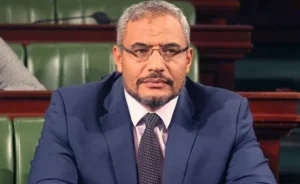

October 2, 2026 – The Misdemeanour Chamber of the Tunis Court of First Instance has sentenced blogger and political activist Hajar Awadi to imprisonment at first instance in the case concerning social media posts she published following a security operation in the Majel Bel Abbès area of Kasserine Governorate. The charges relate to praising and glorifying terrorism, incitement to hatred, and making threats.
Judicial sources informed the Freedom for Tunisia Observatory that the court sentenced her to eight months in prison for explicitly praising and glorifying terrorism, one year for incitement to hatred, and six months for the offence provided for under Article 222 of the Tunisian Penal Code, bringing the total sentence to two years and two months in prison.
Article 222 of the Penal Code provides for a prison sentence ranging from six months to five years for anyone who threatens another person with an act constituting a criminal offence, regardless of the means used to convey the threat, with certain aggravating circumstances specified by law.
The Case Began with Social Media Posts Following a Security Operation in Kasserine
The case dates back to social media posts published by Hajar Awadi in January 2026 following a security operation in the Majel Bel Abbès area of Kasserine Governorate, after which the authorities announced that four individuals they identified as members of a terrorist cell had been killed.
Awadi’s defence team had explained that, based on information circulating at the time, their client published posts in which she described those killed during the operation as “smugglers, not terrorists”, before deleting the post and apologising for it after verifying the information.
According to information obtained by the Freedom for Tunisia Observatory, proceedings against Hajar Awadi were initiated following a complaint filed by dismissed prison officer Walid Zarrouk. The complaint was initially handled by the judicial police unit in Tajerouine before the case was subsequently referred to the Counter-Terrorism Judicial Pole.
Awadi was arrested on January 23, 2026, before appearing before an investigating judge at the Counter-Terrorism Judicial Pole, who issued a detention warrant against her on January 29.
From “Glorifying Terrorism” to Three Charges and Prison Sentences
The new first-instance judgment reveals that the prosecution was no longer limited to the charge of glorifying terrorism that characterised the beginning of the case. The trial ultimately resulted in Awadi’s conviction on three separate counts: praising and glorifying terrorism, incitement to hatred, and threatening to commit an act constituting a criminal offence under Article 222 of the Penal Code.
The judgment is particularly significant given that the case originated from content published on social media. This makes it essential to identify the specific statements and actions relied upon by the court to establish each offence separately, particularly regarding the charges of incitement to hatred and criminal threats, and to explain how the legal elements of these offences were established in the posts at issue.
Position of the Freedom for Tunisia Observatory
The Freedom for Tunisia Observatory expresses its grave concern over the prison sentence imposed on Hajar Awadi in connection with social media posts and online publications. It considers that applying serious charges such as glorifying terrorism, incitement to hatred, and criminal threats to digital content requires the highest degree of scrutiny of the statements attributed to her and of whether the legal elements of each offence have been established independently.
The Observatory emphasises that combating terrorism and direct incitement to violence are legitimate obligations of the State. However, an overly broad interpretation of statements published on social media as constituting glorification of terrorism, incitement, or threats may lead to sweeping and disproportionate restrictions on freedom of expression, particularly when the statements concern comments on a security operation, questioning an official account, or sharing information subsequently found to be inaccurate.
The Observatory further stresses the need to draw a strict distinction between shocking, inaccurate, or irresponsible expression and actual incitement to commit terrorist acts, incitement to hatred, or the making of a specific criminal threat. It emphasises that custodial sentences should only be imposed where the material and intentional elements of the offence have been established through clear evidence.
The Observatory also condemns the use of imprisonment in a case concerning the expression of opinions before less restrictive alternatives have been exhausted. It calls for the judgment to be reviewed on appeal in light of the principles of legality, necessity, proportionality, and freedom of expression.
The Freedom for Tunisia Observatory Calls For:
- The release of Hajar Awadi and for her to be allowed to pursue appeal proceedings while at liberty, unless specific grounds justify her continued detention.
- A review of the judgment on appeal, with careful examination of the acts.
- Avoid the broad or excessive application of charges such as “glorifying terrorism” or “inciting hatred” in response to political expression or commentary on security-related events, unless all precise legal elements of the offense are clearly met.
- Specifically verify the presence of the elements of a “threat” as defined under Article 222 of the Penal Code, including the identification of the targeted individual or entity and the nature of the threatened harm.
- Adhere to the principle of proportionality in sentencing, and refrain from imposing imprisonment solely for the act of expressing an opinion or disseminating false information, unless such actions are accompanied by direct incitement or a credible, specific threat.
- Ensure Hajar Awadi’s right to a defense, the right to appeal, and the right to a fair trial, while upholding the presumption of innocence until a final, definitive judgment is rendered.