Skip links

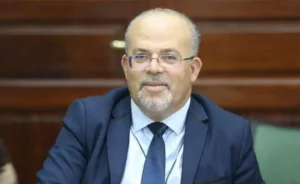
Two-Year Prison Sentence for Dismissed Judge Hichem Ben Khaled Over Facebook Posts

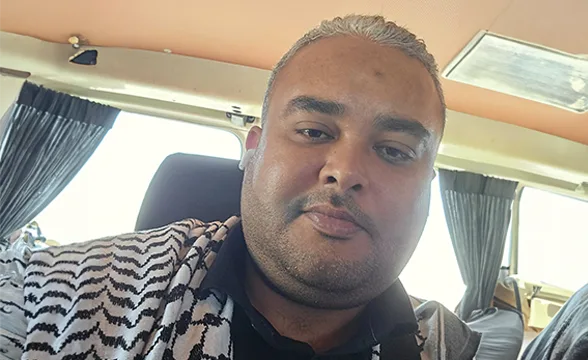
March 3, 2026 – The Criminal Chamber of the Tunis Court of First Instance sentenced dismissed judge Hichem Ben Khaled to two years in prison for three Facebook posts attributed to him, with a seven-month sentence for each post.
 
This ruling comes after the same chamber had decided on February 17, 2026, to reject his request for bail and to postpone the cases against him until the March 2 hearing.

Background:

Hichem Ben Khaled appeared in court on three charges related to “insulting others via public telecommunications networks,” as defined in Article 86 of the Telecommunications Code.
 
He was initially detained by the Central Cybercrime Unit of the National Guard in El Aouina, before the Public Prosecutor issued arrest warrants against him and referred him to the Criminal Chamber while in custody.
 
During the trial, Hichem Ben Khaled refused to appear before the court and did not recognize its legitimacy. He also refused legal representation.

Background of the Case:

Hichem Ben Khaled was among the judges dismissed by presidential decree on June 1, 2022. However, he later obtained a decision from the president of the Administrative Court suspending the dismissal order. This raises a legal issue related to his professional status and the guarantees associated with his judicial position.
 
He has expressed his opposition to the events of July 25 on numerous occasions, criticizing the current authorities in online posts and media appearances. He has also declared his solidarity with several political prisoners.

Legal and Human Rights Issues:

This ruling raises a number of legal issues, including:
 
Firstly, the extent to which the special guarantees associated with judicial position were respected, given the existence of an administrative judicial decision suspending the dismissal.
 
Second, the extent to which the prison sentence is proportionate to the nature of the alleged actions, which pertain to peaceful online posts falling within the realm of freedom of expression.
 
Third, the limits of applying Article 86 of the Telecommunications Code in cases of opinion and expression, and whether resorting to imprisonment is consistent with the principle of proportionality and the presumption of innocence.

The Freedom for Tunisia Observatory’s Position:

The Freedom for Tunisia Observatory believes that sentencing a judge to prison for online posts necessitates a rigorous examination of the extent to which freedom of expression, judicial guarantees, and the principle of proportionality between the act and the punishment are respected.
 
The Observatory also warns against the expansion of criminalization in cases of expression and the adoption of prison sentences in cases related to expressing opinions, which could infringe upon the very essence of public freedoms.
 
The Observatory emphasizes that addressing disagreements or criticisms directed at the authorities through punitive measures that deprive individuals of their liberty raises serious concerns about the climate of freedom of expression and the independence of the judiciary.
 
The Freedom for Tunisia Observatory demands:
  • The release of Hichem Ben Khaled and enabling him to appeal the verdict while on bail.
  • Respect for the legal guarantees related to his professional status in light of the suspended dismissal order.
  • A review of the legal classification of freedom of expression cases to ensure that criminalization is not expanded at the expense of freedom of opinion.
  • The adoption of the principle of proportionality in penalties, particularly in cases that do not involve acts of violence or serious material crimes.
Share

More Posts

Call to Action

Website petition: Freedom for prisoners of conscience and activists in Tunisia!

Tunisia is no longer the Arab exception that inspired the world in 2011 with a heroic revolution that overthrew the rule of Zine El Abidine Ben Ali, who ruled for nearly 23 years after seizing power on November 7, 1987, in a coup against Habib Bourguiba.

In a similar and perhaps more dangerous move, on the night of July 25, 2021, Tunisian President Kais Saied carried out a “constitutional coup” in accordance with his personal interpretation of Article 80 of the 2014 Revolutionary Constitution, announcing that he had taken a set of exceptional measures due to the “imminent danger” that threatens Tunisia without providing any details or reasons.

In accordance with these measures, Saied dismissed the government and the prime minister Hichem Mechichi who was present at the National Security Council that night at the Carthage Palace, and claimed that he had contacted the Speaker of Parliament Rached Ghannouchi (leader of the Ennahdha party) to consult with him in accordance with what is stipulated by the constitution, a claim which Ghannouchi denied since the call was general and did not include anything about exceptional measures or any consultation on the matter. The president suspended Parliament and later dissolved it in March 2022.

Not only did Saied seek to bypass his powers and the articles of the Constitution, which he swore to protect before the Assembly of the Representatives of the People, but he went on to dismiss and change the composition of the Supreme Judicial Council after redefining the judiciary it as a “function” rather than an independent authority. He further replaced members of the Supreme Electoral Commission in preparation for the referendum he held in order to vote on a constitution that he wrote himself after dismissing the proposals of the drafting committee he had himself appointed. Then legislative elections were held over two rounds, in which the participation rate did not exceed 8% of the total number of voters, with the Election Commission later announcing that it had reached 11%, which is the lowest participation rate in Tunisia and globally.

On February 11, President Saied’s regime launched a campaign of protests that has not stopped since, against political leaders, media figures, journalists, judges and senior officials and civil servants, for charges of “conspiring against the security of the state and committing an offensive act against the President of the Republic,” in addition to other charges that were referred to the military prosecution, leading one to wonder about the implication of the Tunisian army in the actions taken by Saied.

The arbitrary arrests were marred by several procedural violations amid criticism from prominent international organizations and observatories in the field of human rights. The standards of litigation and detention period and conditions were not respected. Prosecution and harassment sometimes extended to the detainees’ families, and no evidence, and in many cases, no charges against them were presented.

Moreover trade unions and political parties continue to be subjected to constant harassment and restrictions. Saied continues to target all “intermediary bodies” accusing them of “collaboration” or “treason”. Civil society associations have also been subjected to prosecution, arbitrary arrests and deprivation from representation, in a context of of increasing violence in society due to the authorities’ adoption of racist and discriminatory speeches and rhetoric inciting infighting and violating human dignity.

In light of the above, we, the undersigned, demand the following:

Call for the immediate release of all political detainees, immediately and unconditionally. We also urge the Tunisian authorities to recognize the national and the international human rights treaties they have ratified.
Call on the Tunisian authorities to stop dismantling the nascent democracy and put an end to unfair trials and prosecutions against political opponents of the regime and anyone who criticises it.
Call on all activists and observers to join the national movement for restoring democracy and ending authoritarian rule that has taken Tunisia back to despotism, injustice, and violations of rights and freedoms.