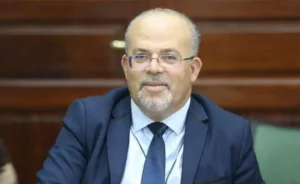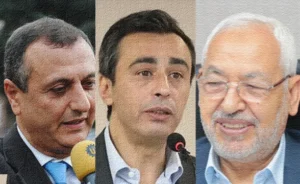
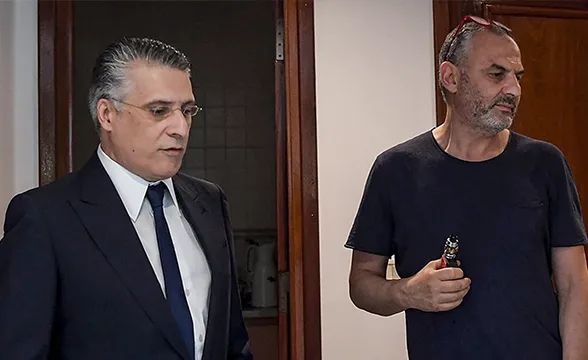
February 28, 2026 – The Criminal Chamber specializing in financial corruption cases at the Tunis Court of First Instance issued a verdict in absentia on Thursday evening, February 26, 2026, sentencing Nabil Karoui and his brother Ghazi Karoui to 14 years in prison with immediate effect. The charges stemmed from crimes related to money laundering by an organized group, the preparation of falsified accounting documents for tax evasion, and the transfer of assets to avoid tax debts.
The court also imposed fines exceeding 37 million dinars, ordered the confiscation of their frozen bank accounts for the benefit of the state and their deposit into a special account at the Central Bank in the name of the Public Treasury, and ordered the confiscation of all their shares in affiliated companies, as well as 20 properties owned by them.
Background of the Case:
On February 5, 2026, the Criminal Chamber decided to postpone the hearing of the case until February 26, after the Karoui brothers were referred to the court in absentia by the specialized financial corruption chamber of the Tunis Court of Appeal, which issued arrest warrants against them.
The charges stem from financial cases that were brought before the Financial Judicial Pole years ago, involving suspicions of tax evasion, money laundering, and other financial and administrative crimes. These cases were previously accompanied by precautionary measures such as travel bans and asset freezes.
General Context of the Case:
The Freedom for Tunisia Observatory notes that the Karoui brothers were among the most prominent political figures in the period leading up to July 25, 2021, the date on which Kais Saied announced the state of emergency measures.
Ghazi Karoui was a member of the dissolved parliament, while Nabil Karoui headed the Heart of Tunisia party, a key player in the parliamentary and political landscape, and a direct rival of President Kais Saied in the second round of the 2019 presidential elections.
The Observatory believes that this political context cannot be separated from the general climate of recent years, which has witnessed prosecutions and harsh sentences against prominent figures from the political class that shaped the landscape before July 25th.
The Observatory warns against entrenching a vindictive tendency or creating an atmosphere where judicial accountability is perceived as primarily targeting figures associated with the previous political era or those who have engaged in political disputes with the current authorities, which could undermine confidence in the impartiality of the judiciary.
Observations of the Freedom for Tunisia Observatory:
The Observatory notes that issuing a verdict in absentia raises serious issues concerning guaranteeing the right to a defense and the actual confrontation of evidence, especially in complex financial cases that rely heavily on technical expertise and accounting reports.
The imposition of heavy prison sentences, coupled with the widespread confiscation of assets and real estate, raises questions about the proportionality between the proven offenses and the imposed penalties, and the extent to which full procedural guarantees were respected in a trial held in absentia.
The Observatory affirms that combating corruption remains essential to protecting public funds, but this cannot be achieved in an environment characterized by targeting political opponents or reshaping the political landscape through the criminal justice system.
The Freedom for Tunisia Observatory’s Position:
The Freedom for Tunisia Observatory expresses its concern regarding the increasing number of harsh sentences issued against prominent political figures from the pre-July 25th era, within a tense political climate.
The Observatory emphasizes that the judiciary must not become a tool for restructuring the political landscape or settling scores with former actors, but rather must remain a neutral legal framework based on the precise individual evidence of criminal acts.
The Observatory also emphasizes the need for a strict separation between legitimate judicial accountability for proven financial crimes and any political exploitation that may target figures known for their opposition to or rivalry with the current authority.
The Freedom for Tunisia Observatory demands:
- Guaranteeing the Karoui brothers’ right to appeal the verdict before higher courts.
- Reviewing the verdict to ensure respect for the principle of proportionality between the proven acts and the imposed penalties.
- Ensuring all conditions for a fair trial are met in financial cases with a political dimension.
- Ceasing the persecution of political opponents and the targeting of figures from the period prior to July 25th, 2021.